RS485 hydrogen chloride transmitters are mostly used in chemical plants, chlor-alkali plants and other scenarios, with the key function of stably monitoring corrosive gases. Mastering the following practical tips can effectively extend the service life of the equipment and ensure measurement accuracy.
1. Installation and Site Selection: Avoid Interference in Line with Product Characteristics
Hydrogen chloride is heavier than air, so install the transmitter 0.3-0.6 meters below the potential leakage source.
Arrange the air inlet facing downward to prevent condensed liquid from flowing back and damaging components.
Keep away from air conditioning air outlets and frequency converters to avoid environmental and electromagnetic interference.
2. Wiring Specifications: Ensure Stable Communication Operation
Use shielded twisted pair cables, connect wires A and B firmly in the correct corresponding order, and never reverse the connection.
The default terminal resistance is 120Ω, with no need for additional installation and configuration.
Adopt a single-end grounding method to avoid frame errors caused by ground loops.
3. Daily Inspection: Conduct Unremitting Daily and Weekly Checks
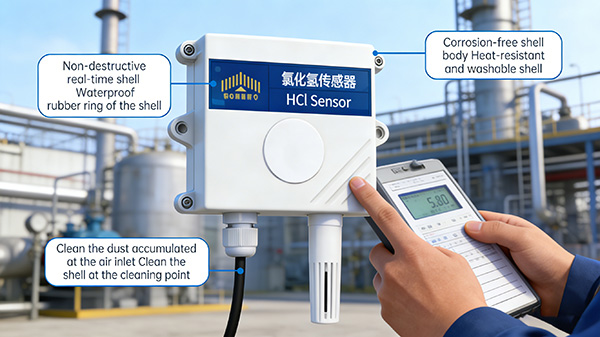
Check daily for no damage to the housing and no aging or cracking of the waterproof rubber rings.
Ensure no abnormal heating of the housing when touched and no frequent jitter of the reading data.
Wipe the housing with a dry cloth and remove dust from the air inlet every week.
4. Regular Calibration: Control Errors to Ensure Accuracy
Perform manual calibration every 30 days under normal conditions; shorten the interval to monthly in highly corrosive environments.
Use standard HCl gas for calibration, conducting zero-point calibration first and then range calibration.
Record calibration data after the operation and attach a qualified label for future reference.
5. Corrosion Prevention: Safeguard the Hardware Safety
Select accessories made of PTFE material and apply silicone grease to the interfaces to enhance sealing performance.
After a high-concentration gas leakage, rinse the air inlet with deionized water and then air-dry it thoroughly.
Replace the electrochemical sensor every 2-3 years and make timely replacement when it reaches the service life.
6. Troubleshooting: Locate and Resolve Problems Quickly
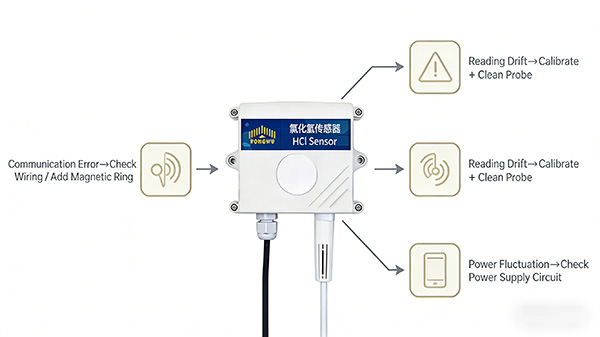
For communication abnormalities, check the wiring first, and a magnetic ring filter can be installed to resist interference if necessary.
Perform calibration promptly for reading drift and clean the sensor probe at the same time.
If the power supply fluctuation exceeds ±5%, inspect the stability of the power supply circuit.
7. Maintenance Taboos: Abide by Specifications Strictly
Do not disassemble the probe or junction box with power on to avoid short circuit.
Do not clean the probe with a metal scraper or rinse the housing with high-temperature steam.
Do not modify the manufacturer-set parameters at will to prevent equipment performance failure.