
Categories
New Blog
Practical Science Popularization of RS485 Water Quality Blue-Green Algae Sensor: Practical Selection Guide for Water Algae Monitoring
March 17 , 2026
Outbreaks of blue-green algae in rivers, lakes, drinking water sources, aquaculture ponds and other water areas have long been a tricky water quality problem. Mild outbreaks damage the aquatic ecosystem, while severe ones release algal toxins that threaten drinking water safety and affect aquaculture profits. Traditional monitoring relies entirely on manual sampling combined with laboratory microscopic examination, which features cumbersome processes, long time consumption and serious lag in data feedback, making real-time early warning impossible. In addition, scattered field monitoring points and complex environments lead to high difficulty and costs in manual inspection, which cannot meet the digital monitoring requirements of smart water affairs, creating a rigid demand for industrial-grade online sensing equipment.
This RS485 water quality blue-green algae sensor achieves accurate detection based on the fluorescence spectroscopy method, requiring no chemical reagents or water sample pretreatment throughout the process, and enabling direct in-situ monitoring by submerging into water. Relying on the unique phycocyanin and chlorophyll fluorescence characteristics of blue-green algae, the equipment is equipped with a dedicated excitation light source and a high-sensitivity photodetector. After exciting the algal cells to generate characteristic fluorescence, it quickly converts the fluorescence signal into algae concentration values through a built-in algorithm and temperature compensation model. With fast response and high detection accuracy, it truly reflects the real-time algae situation of water bodies, completely solving the lag problem of traditional detection.
The RS485 communication interface is the key to the equipment’s adaptation to industrial scenarios. As a mature industrial serial bus, it supports half-duplex communication and is compatible with the standard Modbus-RTU protocol, boasting three major advantages:
1. Long-distance transmission: Stable data transmission within kilometers for field monitoring points;
2. Strong anti-interference capability: Resists electromagnetic interference and ambient stray light around water areas, ensuring no data packet loss or distortion;
3. Easy networking: Multiple sensors can be connected in parallel to easily interface with data loggers, PLCs and IoT cloud platforms, building a global monitoring network for remote data management and control.
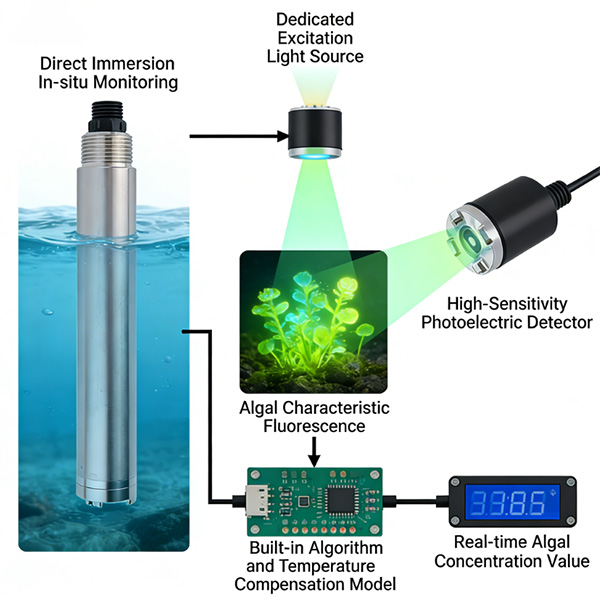
Aiming at the outdoor scenario of water quality monitoring, this sensor has been fully optimized in hardware design for practicality: the whole machine reaches IP68 waterproof and dustproof grade, with a corrosion-resistant shell resistant to water flow scouring, supporting submerged all-weather operation; equipped with a self-cleaning probe structure, it effectively avoids interference from sediment and algae adhesion, greatly reducing manual cleaning frequency and operation and maintenance costs. Meanwhile, it features a wide monitoring range covering conventional water bodies to heavily polluted eutrophic water bodies, as well as low power consumption, making it suitable for field monitoring scenarios without external power supply, achieving excellent durability and practicality.
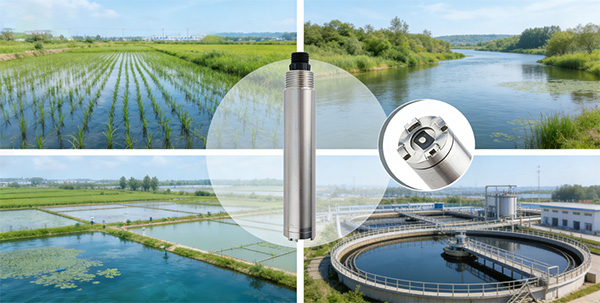
At present, RS485 water quality blue-green algae sensors have been widely deployed in various water scenarios: they build a solid safety line for drinking water sources, track algae dynamics in real time for natural rivers and lakes, provide early warning of algal bloom outbreaks for landscape water bodies and aquaculture ponds, and control effluent quality for sewage treatment plants. Relying on the digital transmission capability of RS485, the equipment perfectly connects the whole process of "data collection-transmission-analysis-early warning". It serves as both a "scout" for algae monitoring and a core device for refined water environment management, boosting the quality and efficiency of smart water affairs construction.https://www.zonewuiot.com/water-quality-sensors_c1

Tel : +86 18146178586
Whatsapp : +86 18146178586
Email : qui@zonewu.com
Add : 1501-3, Building F03, Phase III, Software Park, Jimei District, Xiamen City, Fujian Province, China